
Online Phlebotomy Technician Class & Certificate
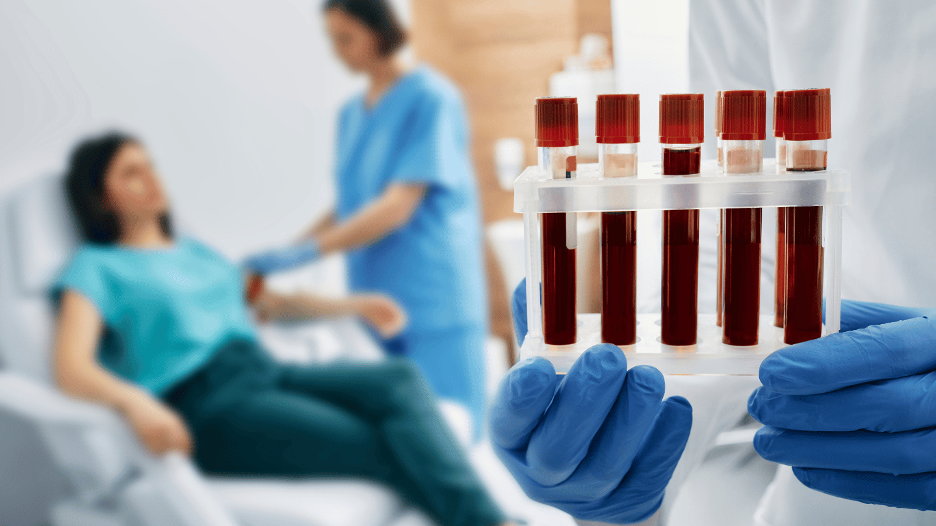
Program price: $550, including the textbook and phlebotomy simulation skills kit.
Enrollment and tuition collection are pending required approval. You may submit a no-cost application for review; this does not constitute admission, enrollment, or a reserved seat.
Program Overview
The Phlebotomy Technician Program at Stonecrest Health is a structured, online training program designed to provide students with foundational knowledge and skill development in blood specimen collection and handling. The curriculum emphasizes patient safety, infection control, proper specimen processing, and professional communication within healthcare environments.
What You Will Learn
Venipuncture and capillary puncture techniques

Specimen handling and processing

Medical terminology related to phlebotomy

Professionalism, documentation, and HIPAA compliance

Anatomy and physiology of the circulatory system

Safety and infection control (OSHA guidelines)

Patient preparation and communication
Special collection procedures





Duration
4-6 Weeks (Self-Paced)
90 days allowed
Format
100% Online + at Home Skills
Certification
National Certification Exam Preparation — Eligibility Requirements Apply
Cost
$550 (Payment Plans Available)
Phlebotomy Technician Training: A Career Path to Success
Our Phlebotomy Technician Training program is designed for the busy online student so that you can complete studies at your own pace no matter where you are located.
$43,660 Median Salary*

CPT Certification Prep
Program Details
The Phlebotomy Technician Program at Stonecrest Health prepares students for national certification examination with the knowledge and practical skills required to perform blood collection procedures in clinical and laboratory settings. Our intensive program includes instruction in medical terminology, infection control, patient identification, venipuncture and capillary collection techniques, specimen handling, safety and compliance standards, and professional communication. Completion period: This self-paced program allows 90 calendar days from your individual course start date to complete all required coursework and skills demonstrations. Students may start on any day of the week once enrollment is available and required course access is provided. An extension of up to four weeks may be granted following a documented request and completion plan approved by the instructor before the original deadline. Students are allowed to work at their own pace. Completion of each section, verified by an exam or quiz, unlocks the next section. We have a final exam to check your knowledge.
Stonecrest Health provides a comprehensive review of clinical phlebotomy standards. Our self-paced curriculum is specifically designed to prepare you for the National Certifying Exams from the NHA, AMCA, and more.
Upon successful completion of the program, students are awarded a Certificate of Completion of our Phlebotomy Technician Course.
Program Delivery Method
This program is offered through distance education and is delivered online using a secure learning management system. Instruction includes recorded lectures, interactive assignments, demonstrations, simulations, assessments, and instructor-guided activities.
Course Objectives
Comprehensive exploration and education about the anatomy and physiology relevant to phlebotomy.
Exposure to phlebotomy techniques using a variety of media with the ability to demonstrate blood draws by the end of the course.
Become familiar with phlebotomy equipment and supplies.
Gain knowledge of appropriate medical terminology used in phlebotomy and professional medical settings.
Explore the different roles and responsibilities of a phlebotomy technician.
Understand how to build a professional resume and secure that first job.
Prepare for a national phlebotomy certification examination, subject to the certifying organization’s eligibility requirements.
Phlebotomy Skills Practicum & Competency Verification
Simulation Skills Training
All students complete structured practice using the supplied phlebotomy simulation skills kit and guided instructional materials. The kit is included in the $550 program price.
Practice the sequence of venipuncture and capillary collection procedures.
Follow demonstrations and standardized competency checklists.
Document 30 venipuncture demonstrations and 10 capillary demonstrations.
Submit required evidence for instructor evaluation and approval.
These demonstrations constitute one required Skills Demonstration module. Every student must satisfy the documented competency requirements before receiving a Certificate of Completion.
Important Disclosure
Simulation demonstrations are school requirements, not live-patient procedures. They do not establish eligibility for national certification examinations. This program does not include live clinical practice or patient contact, and does not guarantee an externship, certification, licensure, or employment. Certifying organizations and employers determine their own requirements.
Flexible Payment Options
Program price: $550, including the textbook and phlebotomy skills kit.
Pay $550 at enrollment, or choose two payments of $275: the first at enrollment and the second two weeks later. The school’s two-payment plan has no added fees or interest.
Apple Pay, Google Pay, Klarna, and Afterpay are available payment options. Klarna and Afterpay eligibility, repayment schedules, interest, and fees are governed by the terms presented by those providers at checkout.
National certification examination fees are not included and are paid separately by the student. Enrollment and tuition collection will begin when officially available following approval.
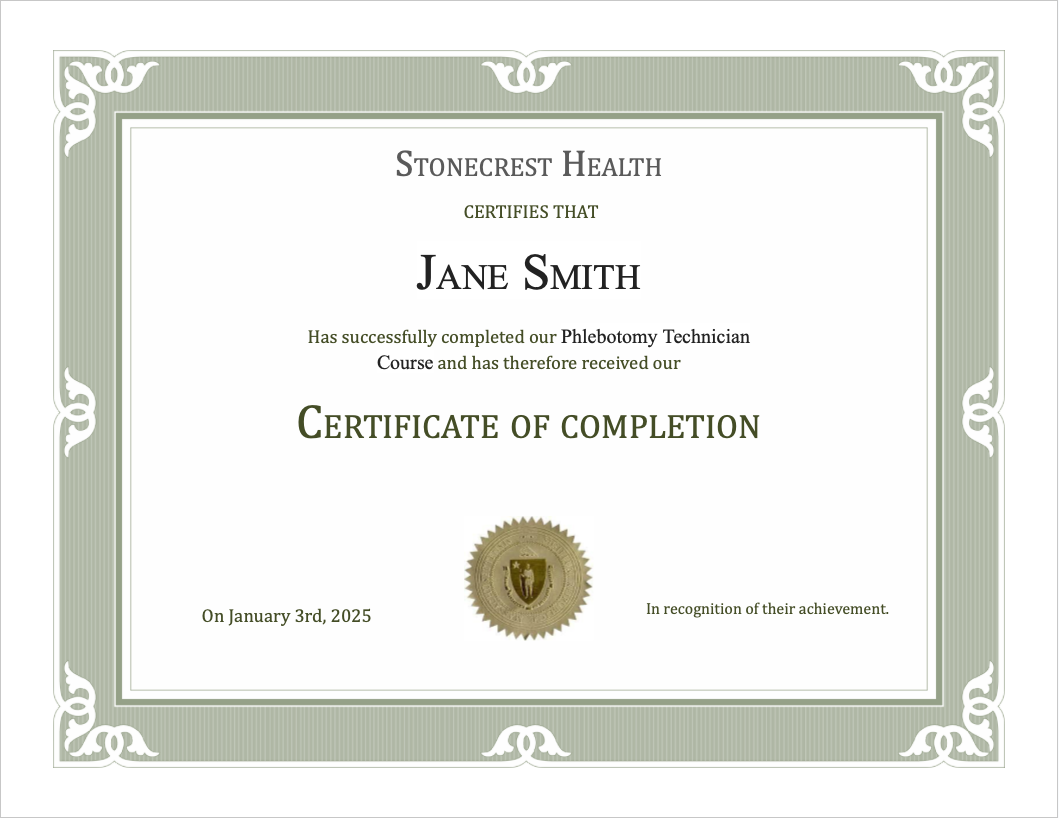
Earn our Phlebotomy Technician Course Completion Certificate
Overview
Looking for a fast, affordable way to launch your healthcare career? Phlebotomy technicians are essential members of the healthcare team, responsible for drawing blood for lab analysis and supporting diagnostic processes. If you’re passionate about patient care and want to enter the medical field without years of schooling, our online course is an ideal starting point.
Stonecrest Health’s online phlebotomy technician program is self-paced and accessible 24/7. The curriculum covers all critical aspects of phlebotomy, including blood collection techniques, specimen handling, infection control, communication skills, anatomy and physiology, and regulatory compliance.
What You'll Learn
This comprehensive course includes in-depth training in:
Venipuncture techniques and proper order of draw
Identifying and accessing veins
Handling difficult blood draws
Point-of-care testing and specimen processing
Anatomy and physiology essentials
Infection control and hazardous materials handling
Patient interaction and compassionate care
Record keeping and healthcare documentation
Phlebotomy scope of practice and professional ethics
Troubleshooting common issues in the field
And much more
Our Course Includes
Structured online lessons, interactive activities, quizzes, and examinations
Video Lectures
Powerpoints
Study Guides
Quizzes and Exams
Phlebotomy skills kit included in the $550 program price
Phlebotomy Technician Certificate of Completion
Instructor support via email, phone, and Zoom
Resume and job search resources
Certification
Students who successfully complete the program receive a Stonecrest Health Certificate of Completion. This school certificate is separate from national certification. Graduates may pursue a national certification examination if they meet the certifying organization’s eligibility requirements, which may include additional documented clinical experience. Program completion does not guarantee certification, licensure, or employment.
Flexible Online Learning
Completion period: This self-paced program allows 90 calendar days from your individual course start date to complete all required coursework and skills demonstrations. Students may start on any day of the week once enrollment is available and required course access is provided. An extension of up to four weeks may be granted following a documented request and completion plan approved by the instructor before the original deadline.
You’ll have 24/7 access to mobile-friendly modules designed and supported by an experienced Healthcare Instructor with Clinical Experience throughout the program.
Upon enrollment, students receive immediate access to their personalized course dashboard. Instructors are available by email and phone, and Zoom support sessions can be scheduled by appointment.
Skills Requirements for All Students
All students must satisfy the program’s documented skills and instructor-evaluated competency requirements before receiving a Certificate of Completion. This includes 30 Venipuncture and 10 Capillary demonstrations
Career Outlook
Phlebotomy training develops foundational knowledge and simulation skills for entry-level specimen-collection work. Employer qualifications, clinical experience, certification, and licensing requirements vary by role and location. Completion does not guarantee employment or a particular salary.
Prerequisites
Applicants must be at least 18 years old and have a high school diploma, GED, or equivalent. Reliable internet access and a compatible computer or device are required. No prior medical experience is required.
Certificate of Completion and National Certification
Stonecrest Health awards a school Certificate of Completion after all academic and skills requirements are satisfied and approved by the instructor. National certification is separate and subject to the certifying organization’s eligibility requirements. Simulation demonstrations do not establish national certification eligibility.
How to Become a Phlebotomist
If you’re looking for a flexible, entry-level healthcare career, phlebotomy is one of the most direct paths into hospitals, labs, and clinics. Here’s exactly how to become a phlebotomist, and how Stonecrest Health’s online Phlebotomy Technician Program fits into that process.
Step 1: Meet Basic Requirements
Most employers require:
High school diploma or GED
Ability to pass a background check and drug screening
Immunization compliance (varies by employer)
Requirements vary by state and healthcare facility.
Step 2: Complete a Phlebotomy Training Program
The most important step is formal training.
Stonecrest Health’s online Phlebotomy Technician Program provides structured instruction in:
Venipuncture and capillary collection techniques
Circulatory system anatomy and physiology
Order of draw and tube selection
Infection control and OSHA bloodborne pathogen standards
Specimen handling and processing
Preventing pre-analytical errors
Patient communication and professionalism
Our distance learning format allows you to complete coursework on your schedule while building the foundational knowledge employers expect.
Step 3: Build Hands-On Competence
Employers look for practical skill readiness.
Depending on your employment pathway, hands-on experience may include:
Skill development using simulation tools
Supervised collections in a healthcare setting
Employer based training after hire
Clinical experience requirements vary by state and employer.
Step 4: Consider National Certification
Certification is not required in every state, but it can improve job prospects.
After completing training, graduates may pursue certification through a recognized national certifying agency (eligibility requirements apply). Certification typically involves:
Completing an approved training program
Meeting documented collection requirements (if applicable)
Passing a certification exam
Certification standards are set by the certifying organization.
Step 5: Apply for Phlebotomy Jobs
Phlebotomists commonly work in:
Hospitals
Diagnostic laboratories
Outpatient clinics
Blood donation centers
Physician offices
Many employers provide additional supervised training during onboarding.
Why Choose Stonecrest Health?
100% distance-learning format
Career focused curriculum
Structured, step by step instruction
Designed for entry level workforce readiness
Our program is built for students who want a clear, affordable path into healthcare without unnecessary delays.
Ready to Start Your Phlebotomy Career?
Enroll in Stonecrest Health’s Phlebotomy Technician Program and begin working toward entry level healthcare opportunities.
Stonecrest Health provides career-focused training. Employment, certification, and clinical placement are not guaranteed and may require additional employer-based training or supervised experience.
Reasons to Become a Phlebotomist
Choosing a career as a Phlebotomist can be a rewarding decision for several reasons:
Helping Others: As a Phlebotomist, you play a crucial role in patient care. Your work directly contributes to diagnosing and treating illnesses, which can have a significant impact on patients’ health and well-being.
Growing Demand: The healthcare industry is one of the fastest-growing sectors, and the demand for skilled Phlebotomists is on the rise. This growth is expected to continue in the future, offering job security.
Quick Entry into Healthcare Field: Training to become a Phlebotomist typically takes less time compared to other healthcare professions. This allows for a quicker entry into the healthcare field, making it an excellent choice for those eager to start their careers.
Stepping Stone: Working as a Phlebotomist can also serve as a stepping stone to other careers in healthcare. The experience and skills gained can be beneficial if you decide to advance your career, perhaps becoming a nurse or a medical laboratory technician.
Variety and Flexibility: As a Phlebotomist, you can work in a variety of settings, including hospitals, diagnostic laboratories, blood donation centers, and doctor’s offices. There are opportunities for both full-time and part-time work, offering flexibility.
Continuous Learning: The field of phlebotomy offers continuous learning opportunities. As medical technology advances, you’ll have the chance to update your skills and knowledge, making it an exciting field for lifelong learners.
Becoming a Phlebotomist can offer a fulfilling career with numerous opportunities for growth and development. It’s a role that not only offers personal satisfaction but also makes a significant difference in the lives of others.
About Phlebotomy
Phlebotomy is a specialized area of clinical laboratory work that involves drawing blood from patients for various medical tests, transfusions, research, or blood donations. Phlebotomists are trained healthcare professionals who carry out these tasks.
Role and Responsibilities: Phlebotomists are primarily responsible for collecting blood samples from patients in a safe and sanitary manner. They prepare patients for the procedure, explain the process, and ensure patients feel comfortable. They also label and track the blood samples to ensure they are correctly matched to each patient.
Skills and Qualifications: Phlebotomists need to have excellent hand-eye coordination and precision to draw blood efficiently and minimize patient discomfort. They also need strong interpersonal skills as they interact directly with patients, some of whom may be nervous or uncomfortable. In terms of qualifications, phlebotomists typically need to complete a phlebotomy training program and obtain certification.
Work Environment: Phlebotomists work in a variety of healthcare settings, including hospitals, diagnostic laboratories, blood donation centers, and doctor’s offices. Their work can be physically demanding as it often involves standing for long periods and handling delicate medical equipment.
How to become a Certified Phlebotomist
Becoming a phlebotomist involves several steps:
High School Diploma or Equivalent: The first step to becoming a phlebotomist is to obtain a high school diploma or equivalent.
Phlebotomy Training Program: Next, you’ll need to enroll in a phlebotomy training program. They typically include both classroom instruction and hands-on training in drawing blood.
Certification: While not always required, many employers prefer to hire phlebotomists who are certified. To become certified, you’ll need to pass an exam and, in some cases, complete a certain number of successful blood draws.
Gain Experience: After completing your training and obtaining certification, you’ll start to gain experience as a phlebotomist. This might involve working in a variety of settings, such as hospitals, blood donation centers, or outpatient clinics.
Continuing Education: As with many healthcare professions, continuing education is important for phlebotomists. This might involve taking additional courses or attending workshops to stay up-to-date with the latest practices and technologies in phlebotomy.
Remember, requirements can vary by state, so it’s important to check with your state’s health department to understand the specific requirements in your area.

*Bureau of Labor Statistics, U.S. Department of Labor. “Phlebotomist” Occupational Outlook Handbook. Accessed April 22, 2025.
Statements found in the United States Department of Labor Occupational Outlook Handbook are not a guarantee of any post-graduation salary, in part because the data used to create the Occupational Outlook Handbook includes workers from differing educational backgrounds, levels of experience, and geographic areas of the country.